Español
 العربية
 Francés
 Русский
 Português
 Deutsch
 한국어


How Are Robot Chassis Used in Agriculture — and Which to Choose?
In agricultural robot projects, what really decides whether a machine can get out and work in the field is often a commonly overlooked core component — the robotic mobile platform. Seeding, spraying, weeding, inspection… almost every field task needs a reliable mobile platform that can carry its implements into the field, hold the line along the rows, turn in tight spaces, and come to a steady stop. Understanding how agricultural robot chassis are used in different field scenarios, and how to choose one, is the first step toward fewer detours in R&D and deployment.
Where Agricultural Robot Chassis Are Used
Open-field work: plots are large and open, row spacing is uniform, and the ground is often uneven with soft soil. The chassis needs greater mobility, enough payload capacity to carry implements and consumables, and the ability to travel long distances between plots — speed and runtime become critical.
Greenhouse work: space is confined, rows are narrow and aisles are short. The chassis has to turn around within a limited aisle width, so the ability to move along the edges and turn in place becomes critical — spatial adaptability matters more here than in open fields.
Orchard inter-row work: the chassis has to drive in a straight line along the crop rows and travel close alongside them — precise row alignment is the core requirement. Crab steering (lateral movement) lets the chassis shift sideways without changing its heading, making it easier to centre on the rows and work close to them.
Research and secondary development: universities, research institutes and companies use a robotic mobile platform as a common baseline, repeatedly validating positioning and navigation, perception, and task algorithms. What matters most in this scenario is whether the interfaces are open and whether further development is easy — not the chassis's performance on any single metric.
What a robot chassis is asked to do differs from one scenario to another: some prioritize mobility, some flexible steering, some precise row alignment, and some open programmability.
The 4WD-4WS Architecture: Chassis Motion Capabilities for Multiple Field Scenarios
A key direction in agricultural robot chassis today is the 4WD-4WS (four-wheel drive, four-wheel steering) architecture — all four wheels can be driven and steered independently. In motion terms, this shows up mainly in the following areas:
Ackermann steering: the inner and outer wheels turn through different angles, giving a single instantaneous center of rotation; used for normal travel within regular row spacing and for long-distance moves between plots;
Turn in place: the vehicle rotates about its own center and can turn around directly where the aisle width allows.
Crab steering (lateral movement): the vehicle keeps its heading while shifting sideways, which makes it easier to work close along the rows, stay aligned with them, and run along field edges;
Four-wheel independent drive: with independent torque distribution, it improves traction on soft, uneven and slippery ground.
With an adjustable wheel track and wheelbase, the same robot chassis can adapt to different row spacings and planting patterns — in open fields, greenhouses and the like. This is what "one platform, many field scenarios" looks like on the ground.
Five Things to Check When Choosing an Agricultural Robot Chassis
Payload capacity: whether it can carry the weight of the implements plus the consumables (seed, spray liquid, fertilizer, etc.) and still leave a margin;
Runtime and working duration: whether it can cover one shift of field work (whether the no-load or full-load runtime meets the work cycle);
Speed range: whether it covers both the higher speeds needed for transfers and the low speeds at which precision work stays stable;
Motion capability: whether it supports turning in place, crab steering and the like, to suit confined spaces such as greenhouses and inter-row work.
Openness: whether standard development interfaces and communication protocols are open, and whether in-house positioning and navigation, environmental perception and task control algorithms can be integrated quickly — this directly affects R&D cycles and secondary development costs.
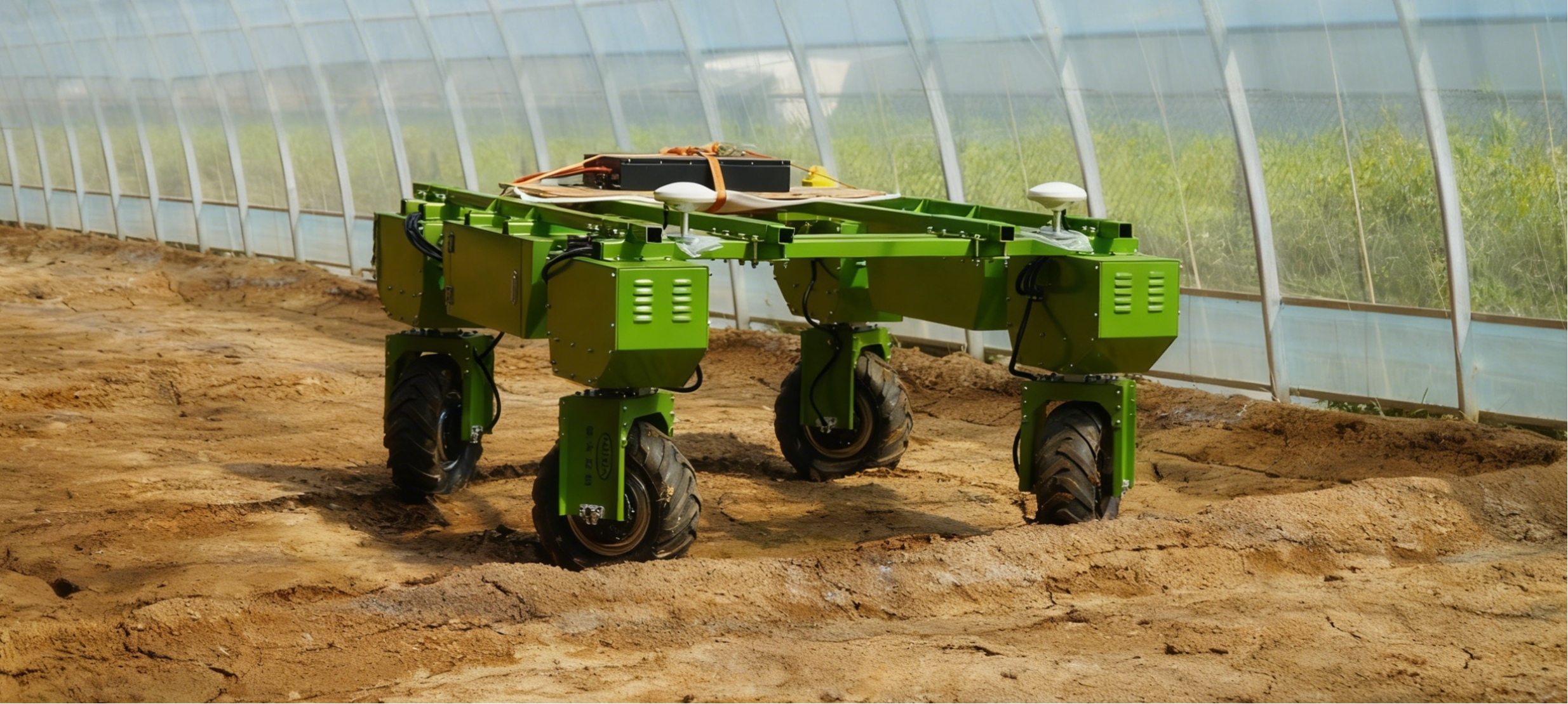
RMP-WL300 Wheeled Chassis: One Platform, Many Field Scenarios
The RMP-WL300 chassis, built on the 4WD-4WS architecture, is precisely a robot development platform designed for multiple agricultural applications and for secondary development:
Rated payload 300 kg, customizable up to 600 kg; can carry various types of implements for seeding, spraying, weeding, inspection and other tasks;
Runtime about 6 hours with no load and about 4 hours at full load; covers most routine working periods;
Working speed adjustable from 0 to 6 km/h, balancing transfer efficiency and low-speed precision work;
Supports Ackermann steering, turning in place and crab steering, with adjustable wheel track and wheelbase to suit different row spacings and planting patterns in open fields, greenhouses and similar settings;
Open CAN and Protobuf protocols; compatible with ROS1 and ROS2, with driver and interface layers provided separately for each framework; allows direct integration of in-house algorithms, enabling hardware–software decoupling and parallel development.
For universities, research institutes and agtech companies, the value of the RMP-WL300 robot development platform lies in skipping repetitive development at the chassis level and leaving time and cost for the task-level innovation that truly creates value.
If you are evaluating a robotic mobile platform for an agricultural robot project, feel free to share your scenarios and requirements with us: field scenario (open field, greenhouse or orchard), wheel track and wheelbase requirements, and the implement you plan to mount along with its weight. We will provide an assessment of how well it fits. With our 4WD-4WS chassis, you can build a prototype faster and get your agricultural robot out of the lab and into the field sooner.